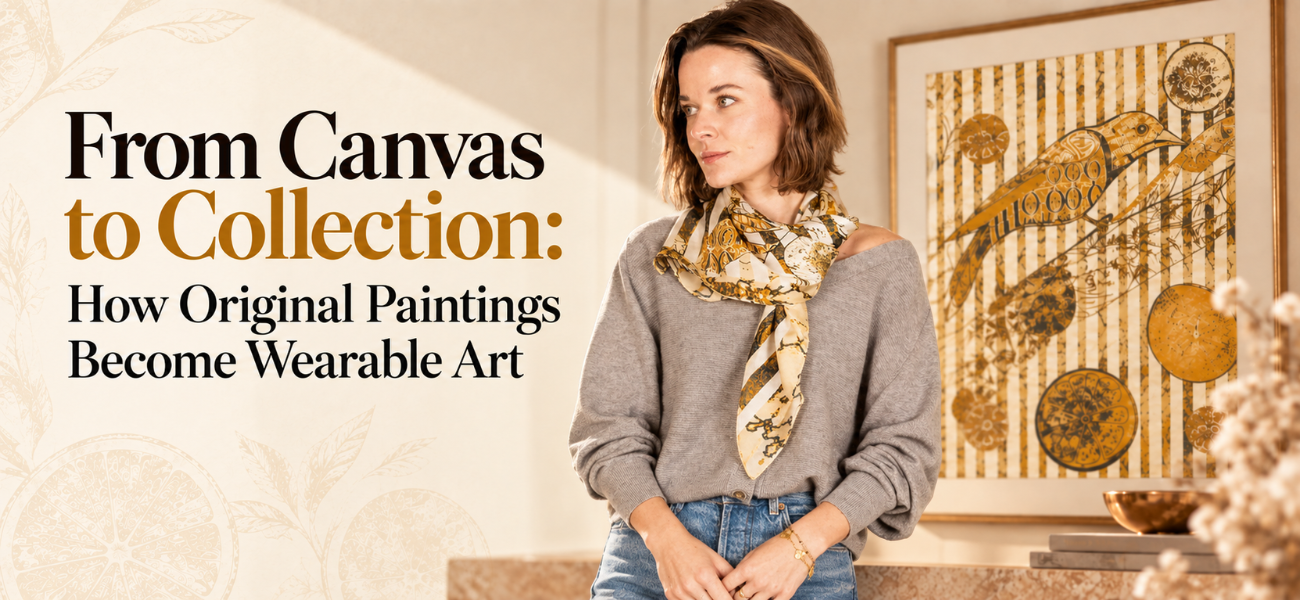
A painting usually lives in one place. It hangs on a wall, and the people who see it are the people who walk into that room. Wearable art changes the terms. When an original painting becomes the source of a scarf, a robe or another piece you can put on, the image starts moving through the world with the person wearing it.
This guide explains what wearable art is, how an artist’s painting can be adapted into something you wear, and how that differs from the original canvas. It also covers what separates artist-designed clothing and accessories from conventional fashion, so you can judge a piece on its own terms.
If you have ever looked at a painting and wished you could carry its colors with you, this is the idea behind art to wear.
Wearable art is clothing or accessories where the design starts with an artist’s creative work rather than a seasonal fashion trend. The image, color palette or composition comes from a painting, drawing or other artwork, then gets adapted to a garment or accessory. The result is something you wear that still carries the artist’s hand and point of view.
The phrase covers a wide range. At one end are one-of-a-kind handmade garments shown in galleries, some of which are closer to sculpture than to clothing. At the other end are pieces made for everyday life, such as silk scarves, robes and accessories, whose designs come directly from an artist’s original work.
Most people searching for wearable art today mean the second kind: pieces they can actually wear to dinner, to the office or around the house, where the design feels closer to a painting than to a print chosen from a trend report.
The defining feature is where the design comes from. In conventional fashion, a design team often builds a pattern around a season’s theme. In wearable art, the starting point is an artwork that existed first, made for its own sake.
Art-to-wear is a closely related term. It describes clothing and accessories conceived as art objects that happen to be worn. You will see “art to wear” and “wearable art” used almost interchangeably in shops, museum programs and search results. Both point to the same idea: the garment is a way of experiencing an artwork, not just a way of getting dressed.
An original painting becomes wearable art when the artist adapts the image, or elements of it, to fit the shape and function of a garment or accessory. That means deciding which part of the painting to use, how large it should appear, where it will fall on the body and how its colors will read on fabric.
That sentence covers a lot of creative decisions. Here is how they usually break down.
Everything begins with the original work. It might be a lively watercolor of flowers, a detailed sketch of birds or a loose, colorful abstract. The painting is finished and complete on its own before anyone thinks about fabric.
This order matters. A pattern designed for a dress is shaped by the dress from the start. A painting that later becomes a scarf keeps its own logic: its focal points, its brushwork and the way the artist balanced color across the surface.
A painting is a rectangle meant to be seen flat and head-on. A scarf is folded, knotted and draped. A robe wraps around a moving body. So the artist has to decide how the image will work in a new shape.
Some questions that come up at this stage:
A square scarf, for example, is often seen as a triangle once folded, or as a narrow band when knotted at the neck. A design that works well as wearable art usually has interest across the whole surface, not only in the center.
Colors on canvas and colors on fabric behave differently. Paint has texture and depth. Fabric has its own sheen, weight and way of catching light. An artist adapting a painting pays close attention to which colors carry the mood of the work and how they will look when the fabric moves.
A soft watercolor might lean on white space and delicate greens. A bold painting might depend on strong contrast. Both can become wearable art, but they will feel different on the body.
Scale changes how an image feels. A small bird painted on a canvas might become large and dramatic across the back of a robe. A large sweep of color might become an intimate detail near the collar of a jacket. Placement determines what people see first when you walk into a room.
The result is not a copy of the painting. It is a new object built from the painting’s visual ideas. That distinction leads to one of the most common questions people have about wearable art.
An original painting is a single physical work made by the artist’s hand. Wearable artwork is a garment or accessory whose design is derived from that painting. The painting is one of a kind. The wearable piece shares its imagery but exists as a separate object with its own purpose.
Both have value, but in different ways:
Owning a scarf based on a painting is a bit like owning a record of a live performance. You are experiencing the artist’s work in another form. It does not replace the original, and it does not try to.
If you want to understand how originals and reproductions differ more broadly, our guide to original art vs. art prints goes deeper into uniqueness, pricing and collecting.
Here is a simple comparison.
| Feature | Wearable Art | Conventional Fashion |
|---|---|---|
| Design starting point | An existing artwork by an artist | A seasonal concept, trend or brand theme |
| Who shapes the look | The artist’s style and subject matter | A design team working to a brief |
| What the piece expresses | A specific painting or visual idea | A trend, silhouette or brand identity |
| How long it feels current | Tied to the artwork, so less tied to a season | Often tied to a particular season or year |
| What buyers value | Connection to the art and the artist | Fit, trend and brand |
Neither approach is better for every person. Many people wear both. The difference is in the story behind the design.
Artist-designed clothing starts with a personal visual language. When you see several pieces from the same artist, you can often recognize recurring subjects, colors or ways of drawing. That consistency comes from the artist’s body of work, not from a brand style guide.
A few qualities to look for:
Sara Anderson’s collections follow this approach. Her site describes original artwork, ranging from lively paintings to intricate sketches, being translated into scarves, loungewear, robes, accessories and home goods. One example is her Sweet Violets scarf, which features watercolor violets and greens on a soft white background.
Accessories are often the easiest way into wearable art. A scarf does not depend on fit, works across seasons and can change the character of a plain outfit.
A painting is turned into a silk scarf by adapting its imagery to the scarf’s shape, choosing how the design will look when folded or draped, and reproducing it on the fabric. The artist decides how to crop, scale and arrange the image so it still reads clearly once the scarf is worn.
Silk and silk blends suit this kind of work because they drape softly and show color well. Sara Anderson’s range includes pieces such as the Butterfly silk-cashmere scarf and the Morning in Italy silk scarf, each built from her artwork.
For ideas on wearing one, see our guide to seven elegant ways to style a silk scarf.
Yes. Paintings are regularly reproduced on garments and accessories. The quality of the result depends on how carefully the image is adapted to the item’s shape, the fabric chosen and how faithfully the colors are reproduced. A good adaptation feels like the painting was meant for that piece, not pasted onto it.
Painting-inspired fashion does not have to be formal or reserved for special occasions. Some of the most satisfying ways to wear art are simple:
The point is not to dress in a costume of art. It is to carry something you find beautiful into ordinary days. Robes are a good example of this. Our article on designer robes explores how painting-inspired designs work on a larger garment.
If you are new to wearable art, these questions can help:
Wearable art is clothing or accessories whose design begins with an artist’s original work, such as a painting or drawing. Instead of following seasonal trends, the piece carries the artwork’s imagery, colors and composition into something you can wear. It ranges from gallery pieces to everyday scarves and robes.
Wearable art is a type of fashion in the sense that you wear it, but its starting point is different. Conventional fashion usually begins with a trend or brand concept. Wearable art begins with an existing artwork, so the design reflects the artist’s style and subject matter rather than a particular season.
No. The original painting is a separate, one-of-a-kind physical work. A scarf or robe that uses its imagery is a new object that shares the design. It lets you enjoy the artist’s work in daily life, but it is not the original canvas and is not collected in the same way.
Paintings with interest across the whole surface often translate well, because folding and draping hide parts of the design. Florals, birds, landscapes and patterned compositions adapt naturally. Strong color relationships also help, since color is usually the first thing people notice when the piece is worn.
It can be, especially for someone who loves art, design or a particular subject such as flowers or birds. A piece of wearable art feels more personal than a generic accessory because it carries a story. Our guide to artist-designed silk scarves as gifts covers how to choose one.
Follow the care instructions provided with the specific piece, since fabric and finishing vary. In general, gentle handling, careful storage away from direct sunlight and avoiding harsh washing will help preserve colors. If a label recommends dry cleaning or hand washing, follow it closely.
Every piece of wearable art begins as something an artist made for its own sake. If you would like to see how Sara Anderson’s paintings and sketches take shape as scarves, robes and accessories, you can browse her collections or read more about her work in the Sara Anderson journal.
Wearable art gives an original painting a second life outside the frame. The artist chooses which part of the image to use, how it should sit on the body and how its colors will read on fabric, and the result is a new object that still carries the painting’s character. Understanding that process makes it easier to choose pieces you will value, whether that is a first silk scarf or a robe you reach for every weekend.