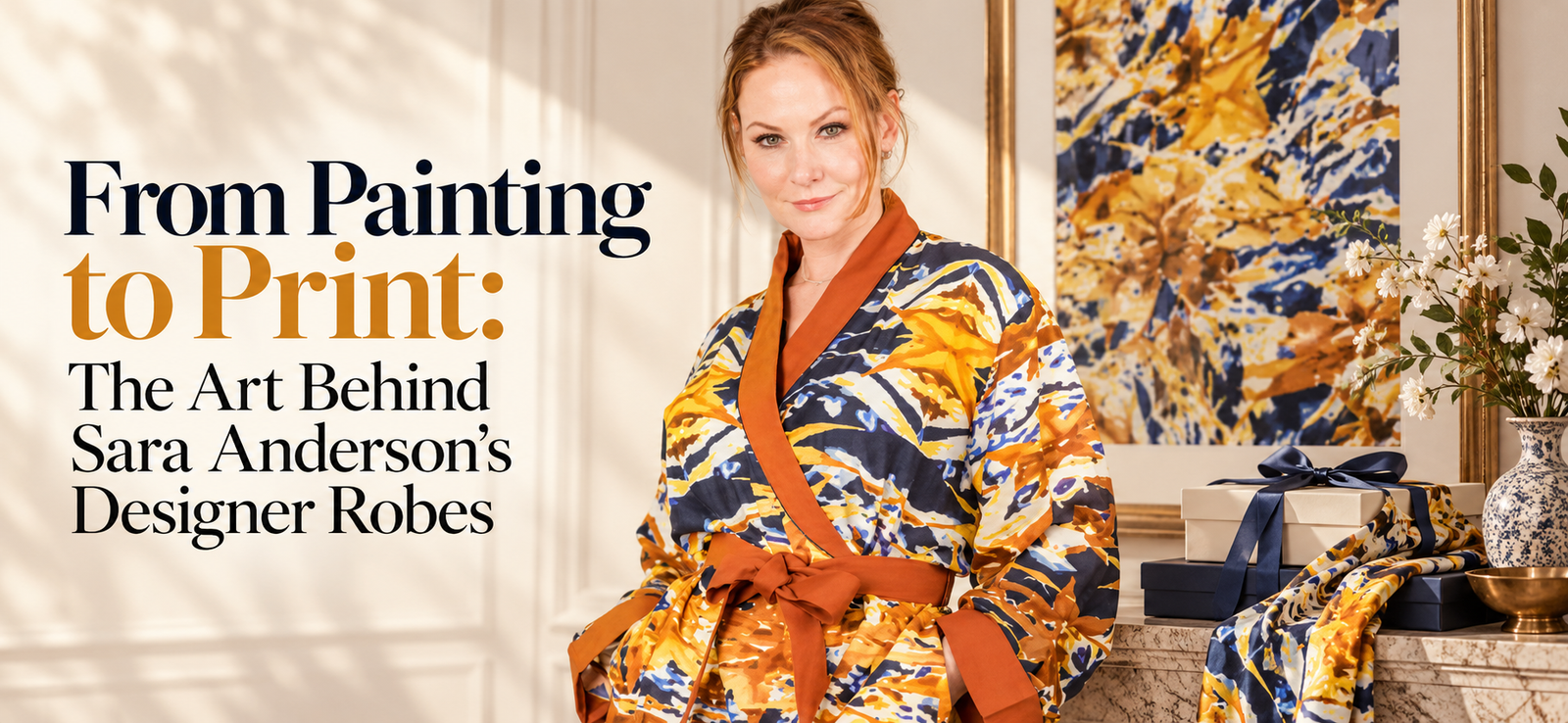
A robe is one of the most personal things you own. It is the first thing you put on in the morning and often the last thing you take off at night. Most people never think about what is printed on theirs. Designer robes that start as paintings change that. They turn a private, everyday garment into something with an artist’s point of view.
This article looks at the path from original painting to finished robe: how a composition made for canvas can become a design made for the body, what makes an artist-designed robe different from a standard one, and how color and subject tell a story on a larger garment. It also looks at how Sara Anderson approaches robes as part of her wider body of work.
Artist-designed robes are robes whose patterns come from an artist’s original artwork, such as paintings or drawings, instead of a generic textile print. The artwork’s colors, subjects and composition are adapted to the robe’s shape, so the garment carries the artist’s visual style. They are a form of wearable art made for everyday living.
A regular robe is usually chosen for comfort and function. It might be a solid color, a simple stripe or a stock pattern. A designer robe adds a second layer of value: the design itself.
In the case of an artist-designed robe, that design comes from a specific artwork. The difference shows up in a few ways:
It helps to think of the journey from canvas to robe as a series of translations. Each stage keeps something from the original and adapts something else.
Everything begins with the painting itself. It is made as a complete artwork, with its own balance of color, line and subject. At this stage it is not a textile design. It is simply a painting.
When a painting is considered for a robe, the composition has to be rethought. A canvas is seen flat and all at once. A robe is seen in pieces: the back panel, the front edges, the sleeves, the collar. Some elements work best as a large central image across the back. Others work better as a pattern that flows from shoulder to hem.
The design then has to work on a moving body. A robe drapes, overlaps at the front and gathers at the waist when tied. Any part of the painting that falls in a fold will be partly hidden. A thoughtful wearable design places key subjects where they will be seen and uses the robe’s length to let the image unfold.
The finished robe is not a copy of the painting. It is a new object that carries the painting’s character into daily life. Our article on how original paintings become wearable art explains this broader process, including how it applies to scarves and accessories.
Paintings are transformed into wearable designs by adapting the artwork’s composition, scale and color to the shape of the garment. The artist decides which part of the image to feature, how large it should appear and where it will fall on the body, so the design reads clearly whether the robe is worn, tied or hanging.
The specific production steps vary by artist and maker. What matters most to the wearer is the result: a design that feels like it belongs on the garment rather than one that was dropped onto it.
A robe gives an artist more room than a scarf. That space changes how color and subject work.
A robe is worn in quiet moments, such as early mornings, evenings and slow weekends. The palette sets the tone for those moments. Soft blues and greens can feel calm. Warm reds and golds can feel rich and cozy. A white background with painted details feels fresh and light.
The subjects in an artist’s work often recur. Birds, flowers, gardens and travel scenes appear again and again because they matter to the artist. On a robe, a subject such as a heron or a flowering branch becomes something the wearer lives with every day.
Unlike a painting on a wall, a robe moves. When you walk, sit or tie the belt, the design shifts. Painted lines seem to flow and colors catch light differently. That movement is part of what makes wearable art distinct from art on a wall.
An artistic robe stands out because its design has an identifiable source and a clear hand behind it. Signs to look for include visible painterly qualities such as brushstrokes or watercolor washes, a subject with personality rather than a generic pattern, and colors that feel chosen as a palette, not simply matched to a trend.
Sara Anderson is an artist and designer whose original artwork, ranging from lively paintings to intricate sketches, is carried into collections that include scarves, loungewear, robes, accessories and home goods. Her robes sit within this larger body of work, sharing subjects and colors with her other designs.
One example is the Heron Blue Robe, whose name points to the kind of natural subject that appears throughout her work. Her loungewear range also includes kimono-style pieces, which offer another way to wear her imagery at home.
Because the robes come from the same artist as her scarves and table linens, they can be part of a wider collection. Someone who owns a Sara Anderson scarf may recognize the visual language when they see her robes, and vice versa.
For specific details about fabrics, sizing and care for each robe, the product pages on Sara Anderson’s website are the best source.
Artist-designed robes appeal to a range of people:
If you are choosing a designer robe for yourself or as a gift, consider these points.
Start with the design. Do you respond to the subject and colors? If you would enjoy looking at the painting, you will likely enjoy wearing the robe.
Think about when the robe will be worn most. Check the product details for fabric information, and choose based on your climate and habits.
Robes come in different lengths and cuts. Consider whether you prefer a shorter robe for warm weather or a longer one for full coverage.
If you or the recipient already own pieces by the artist, a robe with a related design can connect with them. Our guide to artist-designed silk scarves as gifts has more ideas for pairing pieces.
Wearable art clothing is apparel whose design comes from an artist’s original work, such as a painting or drawing. Instead of following a seasonal trend, the garment carries the artwork’s subject, colors and style. Robes, kimonos, scarves and jackets are common formats because they offer space for the design to show.
Original artwork can be used in fashion by adapting its composition, scale and color to the shape of a garment. The artist decides which part of the image to feature and where it will fall on the body. Done well, the result keeps the artwork’s character while working as clothing.
It depends on what you value. If you want a robe mainly for function, a basic robe may be enough. If you care about design, enjoy art or want a robe that makes daily routines feel more personal, an artist-designed robe offers a meaning and visual interest that standard robes do not.
Yes, particularly for someone who enjoys art, comfort and small daily rituals. A robe with an artistic design feels more personal than a standard one. Check sizing and fabric details on the product page before buying, and consider a design that connects to the recipient’s interests.
A robe is a general term for a loose garment worn over sleepwear or after bathing, often with a tie belt. A kimono-style robe borrows its shape from the traditional Japanese garment, usually with wide sleeves and a straight, open front. Both formats can carry artistic designs well.
A robe is worn in the moments that belong only to you. If you would like those moments to include a piece of art, explore Sara Anderson’s robes and loungewear and see how her paintings take shape in something made to be lived in.
Designer robes that begin as paintings bring fine art into the most personal part of the day. The journey from canvas to robe involves rethinking composition, placing key subjects where they will be seen and letting color set the mood. The result is a garment that carries an artist’s vision with every wear, and a reminder that art does not have to stay on the wall.