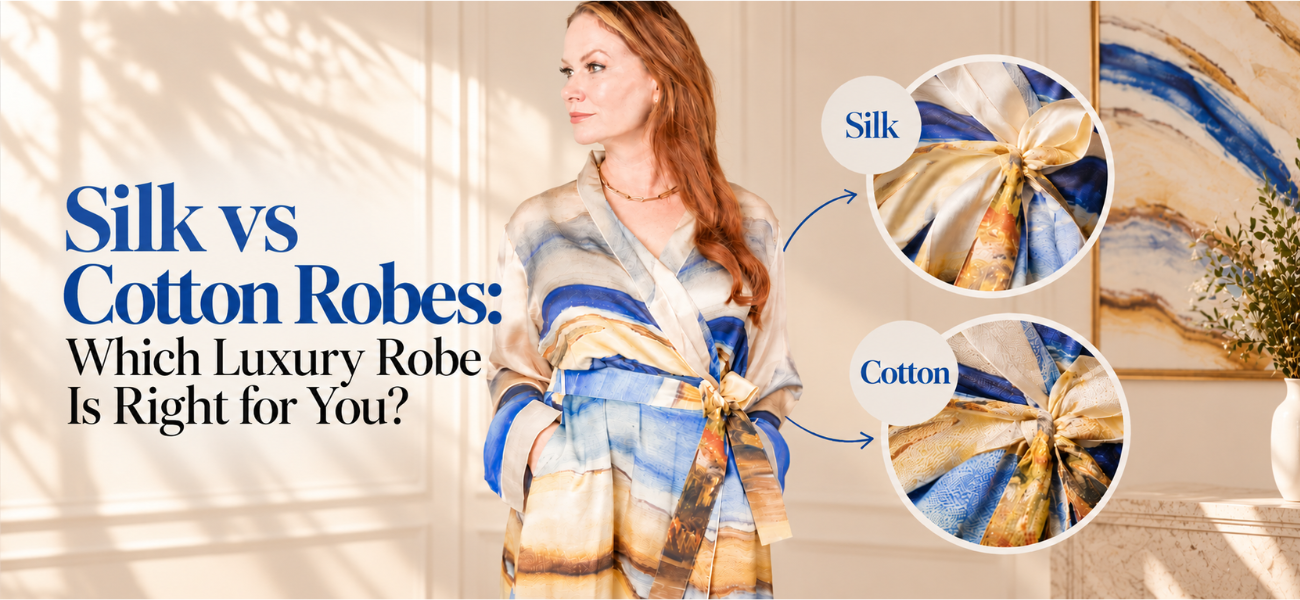
Two robes can share the same cut, the same print and the same tie belt, and still feel nothing alike once you put them on. The difference is the fabric. If you are weighing a silk vs cotton robe, you are really choosing how the garment will feel against your skin, how it will hang from your shoulders, how the print will look in morning light and how much care it will ask of you over the years.
Neither fabric is the right answer for everyone. The better choice depends on what you want from a robe: a smooth, fluid layer that feels like a small luxury, or a matte, familiar fabric that feels easy to live in. This guide explains the real differences between silk and cotton, clears up the common confusion around satin, and walks through what to check before you buy.
Silk is a natural protein fiber produced by silkworms, while cotton is a natural plant fiber that grows around the seeds of the cotton plant. In a robe, silk typically feels smoother, drapes more fluidly and has a soft sheen, while cotton typically has a matte surface and a more relaxed, familiar hand. How either one actually feels depends on the weave, weight and finish of the fabric.
That last point matters more than most buying guides admit. A fiber is only the raw material. The same fiber can be woven in many different ways. Cotton can become crisp poplin, smooth sateen or thick, looped terry cloth. Silk can become glossy satin, pebbly crepe or a light, thin habotai. Two robes labeled “cotton” can feel completely different, and so can two robes labeled “silk.”
So the most useful comparison is not silk against cotton in the abstract. It is one specific robe against another, with the fabric composition, construction and care instructions in front of you.
This is also why it helps to compare the same design in different fabrics. Each robe in Sara Anderson’s collection, including the Heron Blue luxury robe, is offered in three materials: 100% cotton, a 70% silk and 30% cotton blend, and 100% silk with a satin finish. The artwork and the wrap-style cut stay the same, so the fabric becomes the only real decision.
Not necessarily. Satin is a type of weave, not a fiber. A satin weave floats yarns across the surface to create a smooth, glossy face and a duller back. Satin can be woven from silk, polyester, acetate, rayon or cotton, so “satin” on its own tells you nothing about what the fabric is made of.
A silk satin robe is a robe made from silk fiber in a satin weave or with a satin finish. A polyester satin robe may look similar in a photo, but it is a different material with a different feel, and it will behave differently over time. When a product says “satin,” look for the fiber content on the label or in the product details. If it does not say silk, do not assume it is.
Cotton has its own satin-weave cousin, usually called sateen, which has a gentle sheen but still feels like cotton. This is one more reason fabric names deserve a second look before you buy.
The first thing most people notice about a silk satin robe is how it moves. Silk tends to fall close to the body and swing with each step rather than holding a stiff shape. The satin face feels slippery-smooth under the hand, and it glides over sleepwear instead of catching on it.
Silk is a strong fiber for its weight, so silk fabrics can feel substantial without being heavy. A satin finish adds a soft luster that catches light as the fabric moves. On a printed robe, that sheen can make colors look richer and more luminous, especially pale grounds and jewel tones.
Silk asks for more attention than most fabrics. It can be sensitive to heat, harsh detergents and prolonged sunlight, and a smooth satin surface can show snags from rings or rough hardware. Water can sometimes leave marks on silk, depending on the finish. None of this makes silk fragile in daily wear, but it does mean the care label matters. For Sara Anderson’s robes, dry cleaning is recommended to preserve color and fabric, along with storage on a padded hanger away from direct sunlight.
A silk satin robe suits someone who wants the robe itself to feel like an occasion: a slow morning, a getting-ready routine before an evening out, or hosting guests at home.
A woven cotton robe feels the way many people expect a good shirt or a well-made pair of pajamas to feel. It has a matte surface, a slightly drier hand than silk, and a drape that is relaxed without being liquid. For many people, that familiarity is exactly the appeal.
Cotton fibers absorb moisture well, which is one reason cotton is so common in bath and sleepwear. Keep in mind that a woven cotton robe is not the same as a thick terry bath robe. Absorbency depends heavily on how the fabric is built, so a lightweight printed cotton robe is better thought of as a comfortable layer than as a towel substitute.
Because cotton has a matte surface, prints on cotton tend to look softer and more painterly, with less shine. For artwork with watercolor washes or warm, earthy tones, that can be a real advantage. A cotton robe for women such as the Autumn Maple design, with its burnt orange, gold and indigo palette, shows how a matte finish can let a warm print feel cozy rather than glossy.
Cotton often feels less precious, which makes it easy to reach for every day. Even so, do not assume every cotton robe can go straight into a hot wash. Printed and finished cotton garments may still call for gentle or professional cleaning, and Sara Anderson recommends dry cleaning for all three of its robe fabrics.
If you cannot decide, a blend may be worth considering. A 70% silk and 30% cotton fabric tends to combine some of silk’s luster and drape with a little of cotton’s matte body. The exact result depends on construction, so treat a blend as its own fabric rather than half of one and half of the other. The Fair Lady Blue Robe, with its ombré wave print in cool blues and seafoam, is one of the designs offered in this blend as well as in pure cotton and silk satin.
| Factor | Silk or Silk Satin Robe | Cotton Robe |
|---|---|---|
| Fiber | Natural protein fiber from silkworms | Natural plant fiber from the cotton plant |
| Feel and texture | Usually smooth and slippery, especially with a satin finish | Usually matte and familiar; varies widely by weave |
| Appearance and drape | Fluid drape and soft sheen that catches light | Relaxed drape with a flatter, matte look |
| Weight | Often light for its strength; depends on construction | Ranges from light woven fabrics to heavy terry |
| Absorbency | Can take up some moisture, but not designed as a towel | Fibers absorb moisture well; depends on weave and thickness |
| How prints look | Colors tend to look luminous and saturated | Colors tend to look softer and more painterly |
| Care requirements | Usually gentle or professional cleaning; follow the label | Varies; printed or finished cotton may still need gentle care |
| Everyday practicality | Feels special; needs mindful handling | Easy to reach for daily; less precious |
| Price | Often higher; depends on quality, construction and brand | Often lower; depends on quality, construction and brand |
No fabric wins every row. The table is a guide to tendencies, not a ranking.
Start with how you will actually use the robe, then let that guide the fabric.
Budget also plays a role. Silk generally costs more to produce than cotton, and that usually shows up in the price. A higher price, however, is not proof of better quality on its own. Compare the fabric composition, construction and finishing before deciding a robe is worth it.
Whatever fabric you choose, a luxury robe should be able to stand up to a close look. Check these details:
Use this quick checklist when comparing options:
Not universally. Silk is usually smoother and more fluid with a natural sheen, while cotton is usually matte and familiar. The better robe is the one that matches the feel you want, how often you will wear it and the care you are willing to give it.
Silk is the fiber. Satin is a weave or finish. Silk satin is silk fiber woven or finished as satin, which gives it a glossy face and a smooth hand. Silk can also be woven in other ways, such as crepe or habotai, which feel and look different.
Often, yes. Cotton’s matte texture and familiar feel make it easy to wear daily. Comfort still depends on the weave and weight, so check the product details, and follow the care label even for cotton, since printed fabrics may need gentle cleaning.
Cotton is often easier in general, but it depends on the specific garment. Printed and finished robes in any fabric may recommend gentle or professional cleaning. Always follow the care label rather than assuming a fabric can be machine washed.
Look for clear fiber content, a fabric construction that suits the feel you want, thoughtful details such as pockets and a tie belt, a good fit, care instructions you can follow and a design you genuinely enjoy. Price alone is not a reliable sign of quality.
Start with the feel you want against your skin, then consider when you will wear the robe and how you will clean it. Choose silk satin for smoothness and sheen, cotton for a matte, easy feel, or a silk-cotton blend for something in between.
No. Satin describes the weave, not the fiber. Satin robes can be made from silk, polyester, acetate, rayon or cotton. Check the fiber content on the label or product page to know what you are buying.
Follow the garment’s care label. For Sara Anderson’s robes, dry cleaning is recommended. If hand washing, use cold water and a mild detergent, avoid wringing, lay flat to dry and store on a padded hanger away from direct sunlight.
The silk vs cotton robe decision comes down to feel, use and care. Silk satin offers a smooth, fluid drape and a luminous finish that makes everyday moments feel considered. Cotton offers a matte, familiar texture that is easy to live in. A silk-cotton blend sits between the two. Read the fiber content, check the care label and choose the fabric that fits the way you actually live.
If you would like to compare the same artwork across all three fabrics, explore Sara Anderson’s robe collection, where each design begins as an original painting. To learn more about how that artwork reaches the fabric, read how original paintings become wearable art.